List of Continuous Games
A curated and standardised library of continuous-game examples
We present a compilation of parametrized continuous games drawn from both recent and classical literature. Analogous to the Gamut test set of finite games, our suite should provide a convincing and comprehensive benchmark for continuous-game solvers. Specifically, we compiled multiplayer games with continuous utility functions and compact strategy sets and, where possible, with known equilibria.
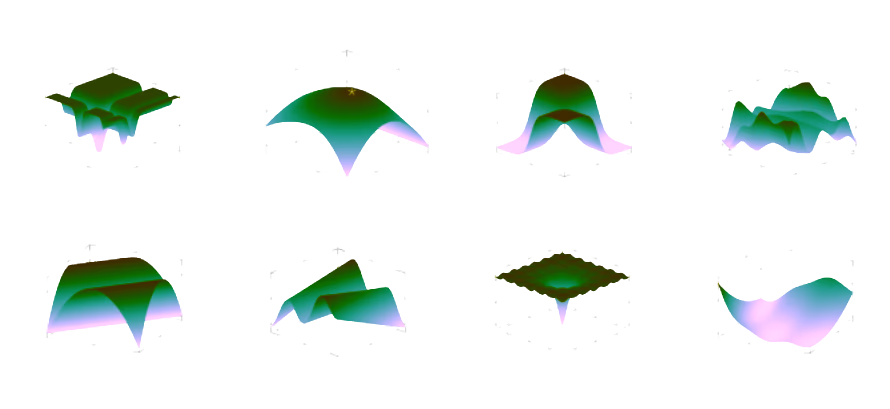
Standardization
Players are identified by successive natural numbers , while their variables are named consistently by followed by two indices indicating the controlling player first and the variable number second. For example, variable 3 of player 4 is referred to as .
Consider the following Tangent Ridge Game with two players, each with a single variable on the interval
The utility functions are defined by:
The game has an equilibrium at .
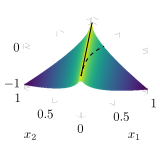
Note that continuous games are complicated, and one game may have many representations. A strategy set as simple as may also be written as or , with all three having potentially different implementations in your solver.
In addition to the game description in a canonical format we also provide a simple and reusable format, where we formulate the constraints for each player in terms of non-negative and equal-to-zero relations. The incentives of players are described by utility functions. In our simplified format the Tangent Ridge game is equivalent to:
NNEG1: x11 >= 0, 1-x11 >= 0
NULL1: 0 = 0
NNEG2: x21 >= 0, 1-x21 >= 0
NULL2: 0 = 0
U1: -sqrt(abs(x11-x21))
U2: -sqrt(abs(x11-tan(x21)))
Browser
TBD